
Why Marinas are Switching their Docks from Wood to FRP
FRP grating panels for dock builders, marinas and waterfront contactors.
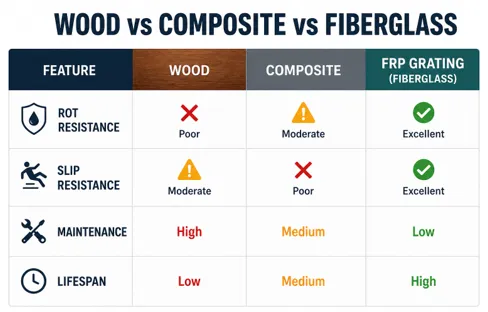
Most replacement projects start the same way. The dock frame is still serviceable, but the wood decking has become soft, slippery, or difficult to maintain. Owners typically evaluate pressure-treated wood, composite decking, aluminum panels, and FRP grating before deciding how much maintenance they are willing to accept over the next 10–20 years.
If you own, build, or maintain docks, you already know the biggest problem with traditional wood decking: it never stops needing attention.
Wood docks may look good at first, but over time they crack, rot, splinter, warp, and become slippery. In commercial marinas, municipal waterfronts, fishing docks, and private waterfront properties, maintenance costs and safety concerns can quickly outweigh the lower upfront price of wood.
That’s why more dock owners and contractors are searching for better alternatives to wood dock decking — materials that last longer, require less maintenance, and perform better in wet environments.
One of the fastest-growing solutions is FRP grating.
Why Wood Dock Decking Falls Short
Traditional pressure-treated lumber has been the standard for decades, but waterfront environments are extremely demanding.
When wood decks get old they tend to rot due due moisture damage, or they may splinter and crack due to the sun and heat. Regardless of the conditions, wood docks require a significant amount of ongoing maintenance and board replacement.
After speaking with many dock builders over the years, we have learned that for commercial docks, marinas, and public walkways, these issues create long-term costs that often exceed the original cost of building the dock.
FRP (Fiberglass Reinforced Plastic) dock grating is a lightweight, high-strength panel designed for corrosive and wet environments. Instead of solid boards like wood, FRP grating uses an open-grid design that allows water, snow, dirt, and debris to pass through.
Many of our customers prefer our 1.5" x 1.5" square mesh grating as the best option for snow as you can stomp you boots and prevent any ice or frozen snow to build up.
FRP Grating is growing in popularity for marina docks, gangways, floating dock, commercial waterfronts and fishing piers.
Key Benefits of FRP Dock Grating:
1. Slip Resistance
Marina operators often tell us they are less concerned with appearance than with reducing annual maintenance and liability from slips. FRP grating has a huge advantage over wood. When wood gets wet, it gets slippery, plain and simple. The slick, wet areas allow algae growth and may even freeze become icy in the winter. Not good.
FRP grating has quartz-grit non-slip surface that is embedded into the grating at the factory providing great traction all year long, even in harsh marine environments. A much safer decking surface.
This makes FRP ideal for public marinas, commercial docks, boat launches, municipal waterfronts and high-traffic gang-ways.
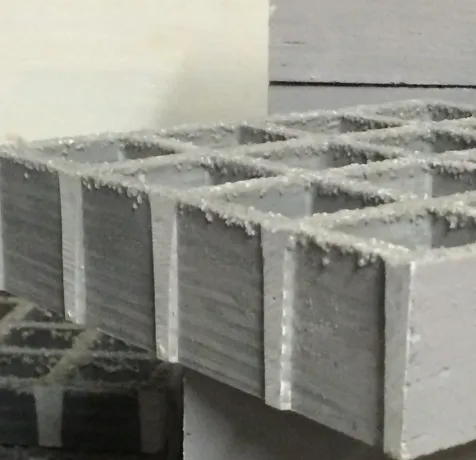
Here is a close-up of the grit on our 1.5" deep grating with 1.5" square mesh. This ideal non-slip suface provides great traction all year round.
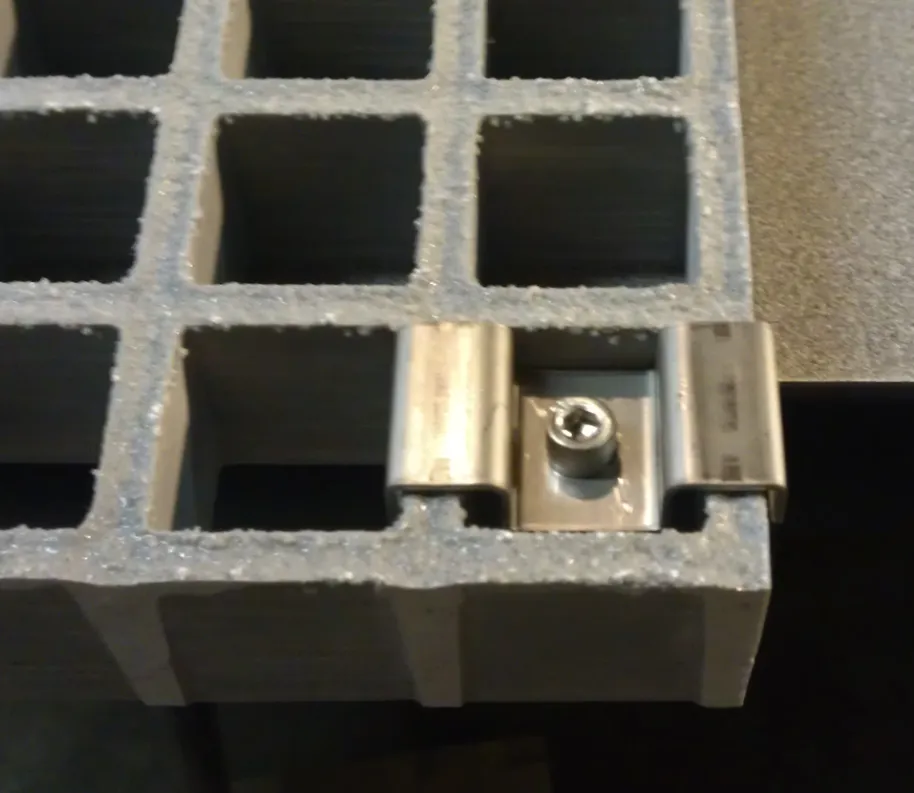
Installation Tip: Be sure to use 316 S.S. M-clips every 3 or 4 feet to fasten the grating to the underlying supports.
Here is a photo showing how our M-clips are used to fasten the grating to the underlying supports.
View our FRP Grating Load Tables to see the deflection at various spans.
Our mini-mesh grating and T-1800 grating are ADA compliant, as the gaps between the bearing bars are 1/2" or less. This allows wheelchairs to safely roll over the bearing bars. Learn more about ADA Accessibility Standards at the U.S. Access Board Website.
2. No Rot or Corrosion
On many older docks, the first signs of failure appear around fasteners and board ends where moisture remains trapped. Unlike wood, FRP will not absorb water or decay over time.
Unlike steel or aluminum, it won't rust or corrode from saltwater exposure.
This dramatically reduces long-term maintenance and replacement costs.
3. Lower Maintenance Costs
Wood docks require sealing, painting, continuous board replacement, pressure washing, and fastener repairs.
FRP grating requires very little maintenance beyond occasional cleaning.
For marina owners and dock builders, this means less labor and lower lifetime ownership costs.
4. Lightweight but Strong
FRP grating is much lighter than steel while still offering excellent strength. Pound for pound, FRP is stronger than steel. For example our 3' x 10 x 1" panels with 1.5" square mesh only weigh 78 pounds.
The lighter panels are easier to install and often reduces structural load requirements for floating docks and gangways.
The supports on many docks we see are on 16" or 24" centers. Our 1' deep molded grating will span up to 2 feet with only 1/4" deflection on a 250 lb concentrated load. Our 1.5" deep grating will span up to 3 feet.
Contractors also benefit from easier transportation, faster installation, less lifting equipment, and simpler field cutting.
For example our 4' x 8' x 1" deep panels with 1.5" square mesh only weigh 110 pounds. Our customers have no problem moving and installing the panels. Check out the weight on all our grating profiles on our FRP Load Tables.
Installation Tip: We have found that using a diamond tip saw blade produces the cleanest cut for trimming the grating. Be sure to wear a mask with a fiberglass filter.
Download our FRP Installation Guide for comprehensive recommendations in the installation and Maintenance of FRP grating. Check out the American Composites Manufactures Association website for more information.
5. Better Drainage
One of the biggest advantages of open-mesh FRP dock grating is drainage.
Rainwater, snow, waves, and debris pass directly through the surface instead of pooling on top like traditional wood decking. Our 1.5-inch square mesh grating has 1-1/4" x 1-1/4" square openings which results in 70% open area, which allows sunlight penetration to meet strict environmental light-mitigation laws for marine habitats.
Be sure to check with your local government authority for any restrictions regarding the minimum amount of open area required to facilitate marine life.
in USA: US Army Corps of Engineers
In Canada: The Marine Transportation Board.
Better drainage on your dock will provide reduced slipping hazards, less standing water, faster drying, cleaner dock surfaces and reduced ice buildup in colder climates.
The Future of Dock Decking
Many of our repeat customers that began their business building wooden docks are moving away from traditional wood surfaces to FRP that offers better performance and lower maintenance. Our grating panels will span 2 or 3 feet which can easily replace existing wooden boards without any changes needed to the support structure.
FRP dock grating has become one of the leading alternatives because it combines durability, slip resistance corrosion resistance, lightweight handling, and a long service life.
For marinas, contractors, municipalities, and waterfront property owners, FRP offers a practical upgrade from traditional wood dock decking. View our Grating Selection Chart.
FAQs About FRP Dock Grating
Is FRP dock grating slippery when wet?
No. FRP dock grating is specifically designed with anti-slip surfaces that provide excellent traction in wet and marine environments.
How long does FRP dock decking last?
FRP grating is designed for long-term performance and can last for decades with minimal maintenance, even in harsh waterfront conditions.
Can FRP grating replace existing wood deck boards?
Yes. FRP grating can often be installed over existing dock structures or used as a full replacement for wood decking, depending on the dock frame and support spacing.
Is FRP More Expensive Than Wood?
The upfront material cost of FRP grating may be higher than pressure-treated lumber.
However, many dock owners discover that FRP becomes more economical over time because it lasts longer, requires less maintenance, improves safety, and minimizes downtime
When evaluating total lifecycle cost instead of initial purchase price alone, FRP often provides a better long-term value.
Author: Richard Neuman. Last update June 7, 2026

Fiberglass Grating for Marine Applications