
PVC vs. FRP Dock Decking
Which Material Is Better for Your Waterfront?
When it comes to replacing or building a dock, choosing the right decking material can significantly impact safety, maintenance costs, and long-term performance. Two popular low-maintenance options are PVC decking and FRP Dock grating. Many of the customers we speak with are learning about these options for the first time. We have help hundreds of customer learn about FRP and helped them make their decision. Hopefully we can help you as well.
While both materials offer advantages over traditional wood docks, they are designed for different applications and perform very differently in harsh waterfront environments.
In this guide, we'll compare PVC and FRP decking side-by-side to see why dock owners, marina operators, and contractors chose FRP as the superior decking material.
PVC Decking
PVC (Polyvinyl Chloride) dock decking is a plastic decking product commonly installed as solid or hollow planks. Similar to FRP, it's popular because it resists rot, insects, and moisture better than wood.
Home owners often chose PVC decking for small residential docks because of its finished appearance and fairly low maintenance requirements.
FRP Grating
FRP (Fiberglass Reinforced Plastic) grating is a structural composite material made from fiberglass reinforcements embedded in a corrosion-resistant resin matrix. Unlike PVC decks or wooden decking boards, FRP grating features an open-grid design that allows water, snow, and debris to pass through.
FRP grating is commonly used in:
Marinas
Commercial docks
Fishing piers
Industrial waterfront facilities
Floating docks
Public boardwalks
Its combination of strength, corrosion resistance, and slip resistance makes it a preferred choice for demanding marine environments.
A commercial marina with carts, equipment, and high foot traffic typically benefits from FRP because of its higher structural capacity and durability in wet environments. FRP is widely used in marine, industrial, and wastewater facilities where corrosion and maintenance are major concerns.
PVC vs. FRP Dock Decking Comparison
PVC decking is designed primarily as a surface material and typically requires closely spaced structural supports underneath.
FRP grating acts as both a decking surface and a structural component, allowing it to span greater distances while supporting heavier loads.
Winner: FRP
For commercial docks, marinas, and heavy pedestrian traffic, FRP offers significantly greater strength.
2. Slip Resistance
Water, algae, and ice can make any dock slippery.
While many PVC products include textured surfaces, they can become slick when wet.
FRP grating is available with molded grit surfaces specifically engineered for high-slip environments. The open-grid design also allows water to drain immediately instead of pooling on the walking surface.
Winner: FRP
Slip resistance is one of the primary reasons marinas and municipalities choose FRP grating.
3. Drainage Performance
PVC decking creates a solid walking surface where rainwater and snow can accumulate whereas FRP has an open-grid, mesh structure. We offer 1.5" x 1.5" square mesh profiles, but many of our customers prefer mini-mesh, which has a 3/4" mesh patten. The small holes in mini-mesh create more surface area, which is much more comfortable to walk, even in bare feet.
The open-mesh grid pattern allows rainwater or melted snow to pass through faster and allows debris to wash away naturally as well as improving airflow around the dock structure. Our 1.5" x 1.5" profile has 70% open space where as mini-mesh has 44% open aresa.
Be sure to check with your local government authority for any restrictions regarding the minimum amount of open area required to facilitate marine life.
in USA: US Army Corps of Engineers
In Canada: The Marine Transportation Board.
Winner: FRP
Superior drainage helps improve safety and reduce maintenance.
4. Maintenance Requirements
PVC requires periodic cleaning to remove dirt, mildew, and algae buildup.
FRP grating requires minimal maintenance because debris does not accumulate as easily on the open-grid surface.
Neither material needs painting or staining.
Winner: FRP (slightly)
Both are low-maintenance, but FRP often requires less cleaning over time.
5. UV and Weather Resistance
Modern PVC decking products are designed to withstand UV exposure but may fade or expand during extreme temperature fluctuations.
Quality FRP grating is manufactured with UV inhibitors and performs exceptionally well in coastal and marine environments.
FRP also experiences less thermal expansion than many plastic decking products.
Winner: FRP
Particularly in regions with wide temperature swings.
6. Appearance
PVC decking resembles traditional wood planks and is often preferred for residential aesthetics.
FRP grating has a more industrial appearance that prioritizes performance over visual resemblance to wood.
Winner: PVC
For homeowners seeking a traditional deck appearance, PVC may be the preferred choice.
7. Lifespan
Both materials can last for decades when properly installed.
However, FRP has a long history of use in highly corrosive industrial and marine environments where failure is not an option.
Many FRP installations remain in service for 25 years or more.
Winner: FRP
Especially in demanding waterfront applications.
Download our FRP Installation Guide for comprehensive recommendations in the installation and Maintenance of FRP grating. Check out the American Composites Manufactures Association website for more information.
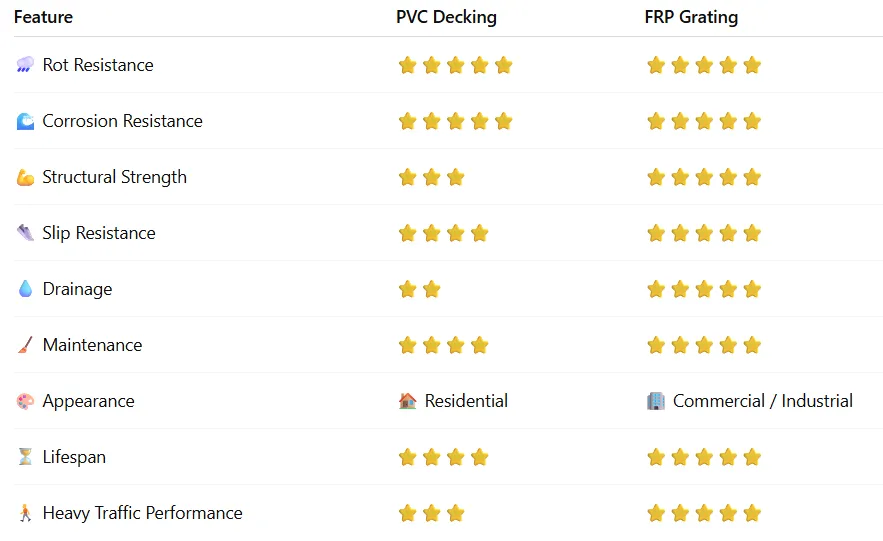
PVC versus FRP Grating Comparison Chart
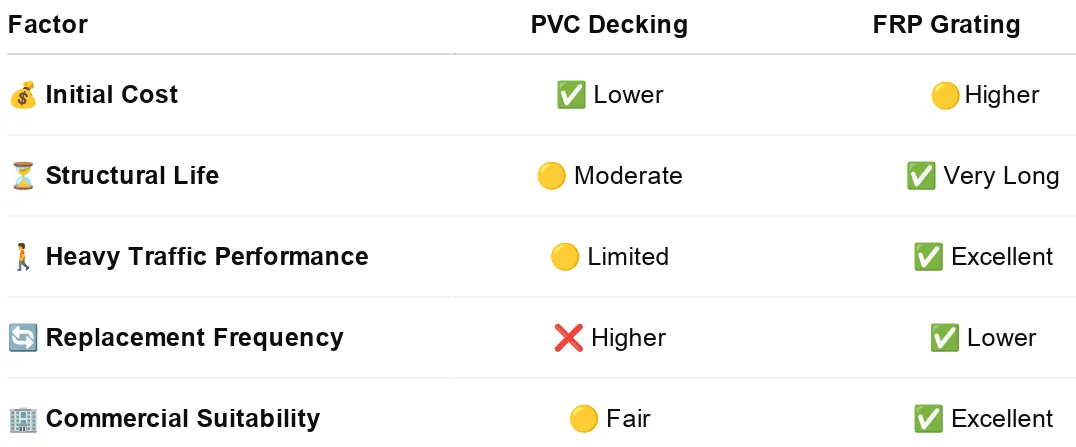
PVC Vs FRP Ownership Cost Comparison Chart
While PVC often has a lower initial purchase cost, docks with high traffic may find FRP's longer life makes the higher upfront cost pay for itself in the long run.
Most of our customers chose FRP because of it's long-term durability and corrosion resistance are priorities.
When PVC Actually Makes More Sense
PVC Grating may be the better choice for small residential docks with ight pedestrian traffic or projects with very tight budgets where maximum structural strength isn't required. PVC decking may be preferred by residential homeowners who prioritize appearance and want a wood-like surface.
FRP grating is often the by far better solution when safety, strength, drainage, and long-term durability are the primary concerns.
For marina docks, commercial waterfronts, and high-traffic public access docks, the superior slip resistance, structural strength, and drainage capabilities of FRP often provide a lower total cost of ownership over the life of the dock.
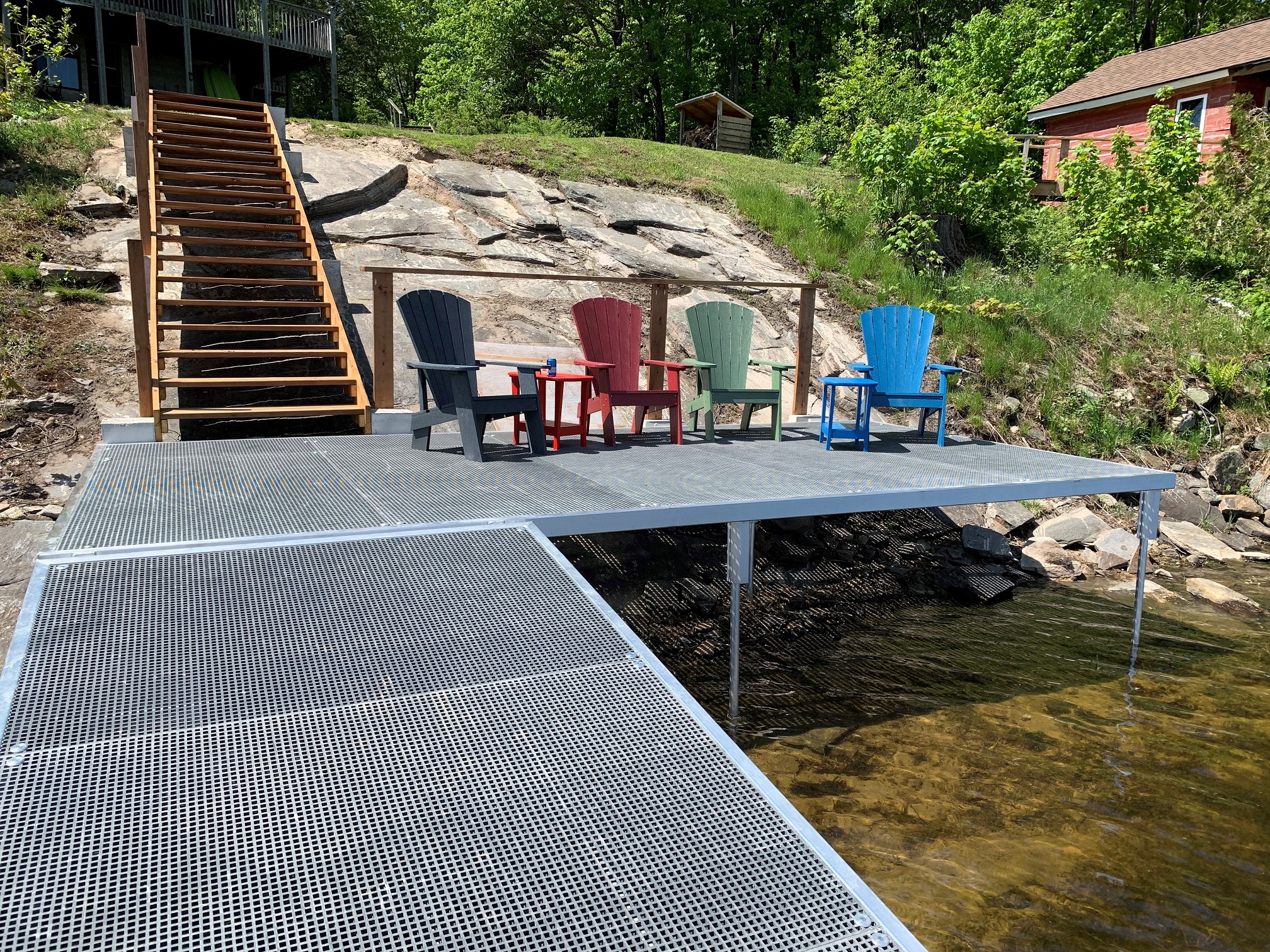
Here is a small seasonal swimming and fishing dock that we supplied the FRP grating for. The home owner is very satisfied how it turned out.
Which Deckikng Option Should You CHose?
CHOSE PVC for:
✅ Lowest upfront cost
✅ Residential dock use
✅ Light foot traffic
✅ Looks are more important
✅ Drainage is not a concern
CHOSE FRP for:
✅ Commercial marina use
✅ Long spans between supports
✅ Heavy traffic
✅ Maximum drainage needed
✅ Lowest maintenance over decades
Frequently Asked Questions
Is FRP grating more expensive than PVC decking?
Initial material costs can vary by project, but FRP often delivers a lower lifetime cost due to its durability, minimal maintenance requirements, and long service life.
Does FRP grating get slippery when wet?
No. Most marine-grade FRP grating includes a non-slip gritted surface specifically designed to provide excellent traction in wet conditions.
Can FRP grating be used on residential docks?
Yes. While commonly used in commercial applications, FRP grating is increasingly being selected for residential docks where safety, durability, and low maintenance are priorities.
If you are planning a dock repair, marina upgrade, or new waterfront project, we would be happy to help you explore the right FRP grating solution for your application. Many of our customers are new to FRP. We can answer any questions you may have and would love to here about you dock project.
Author: Richard Neuman. Last update June 7, 2026

Fiberglass Grating for Marine Applications