
FRP Dock Grating
Fiberglass
Dock Grating
Fiberglass grating panels for dock builders, marinas and waterfront contactors.
FRP grating panels for dock builders, marinas and waterfront contactors.
Fiberglass Grating Options
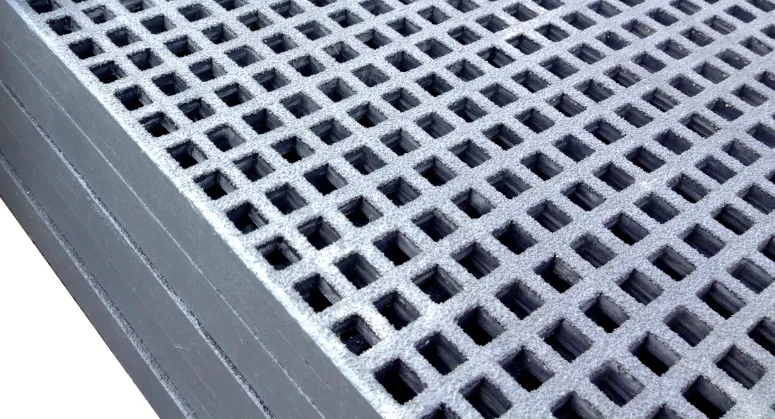
Mini-Mesh Grating
Barefoot friendly, ADA compliant grating. The bearing bars are 3/4" on center forming 1/2" open squares so if you drop you keys you won't lose them! Great for bare feet, flip-flops, or any other type of shoes.
Perfect for residential docks and marinas.
We always have tons of dark gray 4' x 8' and 4'x 12' panels in both 1" and 1.5" deep in stock. We also have limited availability of 3' x 10' and 5' x 10' panels for 10' wide docks and well as small seletion of light grey panels.
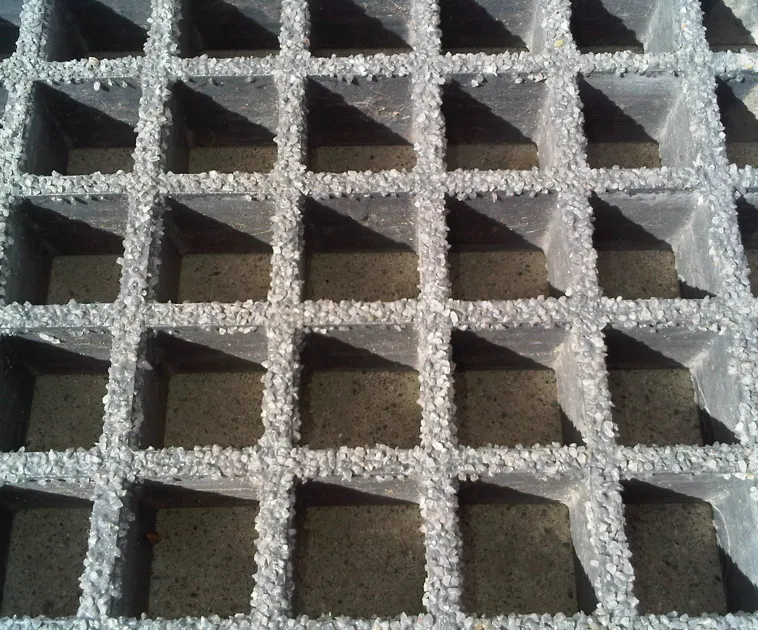
1.5" x 1.5" Square Mesh
Suitable for high-traffic industrial or commercial piers. This grating has 70% open area (1.25" x 1.25" open squares) for maximum light and water penetration.
Due to greater open area, the panels are 20%-35% lighter than the equivalent size mini-mesh panel.
The gritted, non-slip surface is more coarse that mini-mesh offering better traction. The greater spacing between the bearing bars adds better traction for steep ramps.

T-1800 Pultruded Grating
With maximum load-bearing capacity, T-1800 is designed for docks that require the grating to span longer distances. Perfect when the distance between the underlying supports in over 3 feet.
T-1800 has a cleaner look than molded grating so it's a great choice for Marina patio restaurants or home decks.
Stocked in Light Gray 4'x 12 'x 1" deep panels and even stronger 4' x 12' x 1.5".
Grating Selection Chart
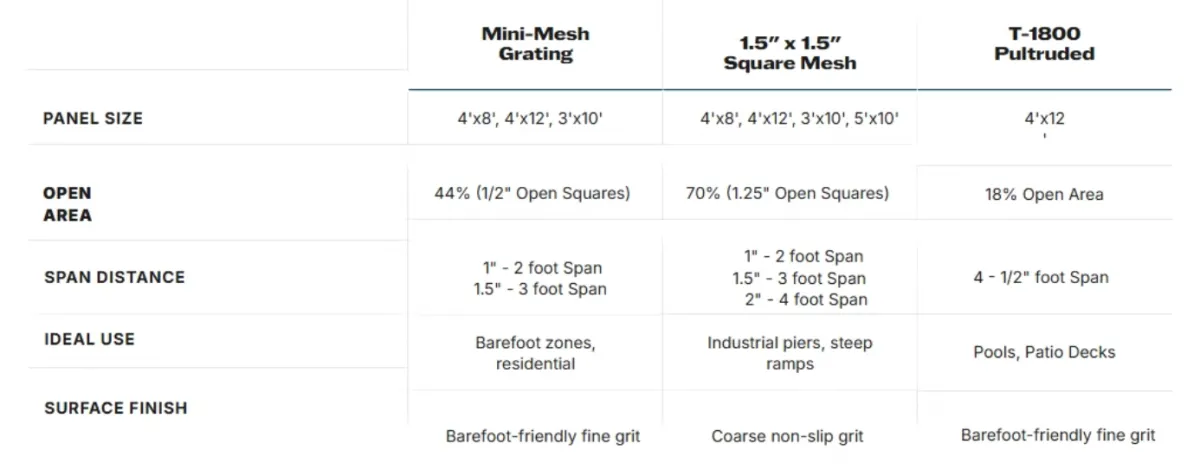
The grating you choose will largely depend on it's primary use and the underlying support structure.
Ask yourself these questions if you are just getting started:
Who is walking on the dock?
What footwear are they likely to be wearing?
How are apart are the underlying supports?
Is a flat deck or a steep ramp?
What is the length and width for the grating needed?
Most of our customers that would like to walk on the grating in bare feet pefer mini-mesh and T-1800. Both profiles have significant surface area and small gaps between the bearing bars, so they are very comfortable to walk on in bare feet. Both options have a non-slip surface using fine grit that is embedded in the grating. Mini-mesh and T-1800 have the perfect surface for both comfort and safety.
If you don't plan on walking on the grating in bare feet, our 1.5" square mesh grating is a great alternative. 1.5" square mesh panels are lighter than mini-mesh as there is less surface are. This also make the panels lighter and less expensive. We recommend 1.5" square mesh for ramps and the greater open area (1-1/4" x 1-1/4" squares) provides better traction.
Determining Panel size
Once you've decided on a grating profile and the desired thickness, he next step is select the best panel size for your project. The 'best' panel size is the size that provides the best yield and least waste, with the least amount of cutting. Typically, the width the dock matches the panel size. A 3' wide dock will use 3' x 10' panels, and a 4' wide dock will use 4' x 8' or 4' x 12' panels. We;ve had several customers with 6-foot wide docks that have used 4' x 12' panels cut in half to make the 6-foot width.
We would be happy to discuss these options with us anytime. Provide us with some basic details using our online form and let's set up a call!
Determining Grating Thickness
Once you've decided on a profile, you will need to determine the thickness of the grating required. The thicker the grating, the stronger the grating, and the greater distance it can span. Clear span is the distance between the underlying supports.
The general rule of thumb is for mini-mesh and 1.5" square mesh is spans of 2-feet or less, you can use 1" deep grating. For spans up to 3-feet we recommend 1.5" deep grating.
T-1800 1" deep can span 3 feet, whereas T-1800 1.5" can span 4 feet.
You can determine the amount of deflection (bend) in the grating at various spans on our Load Tables.
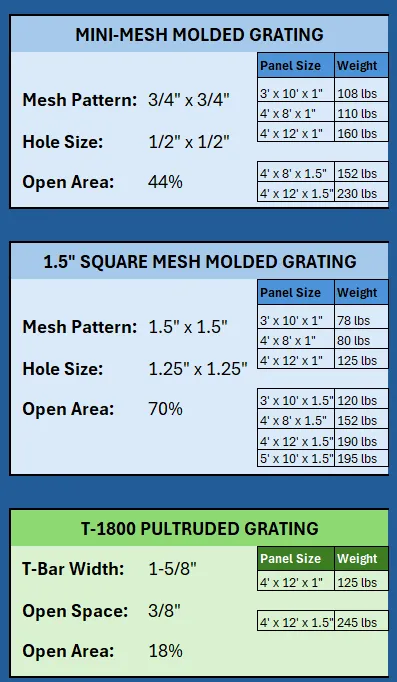
Dock Grating Load Capacity Chart
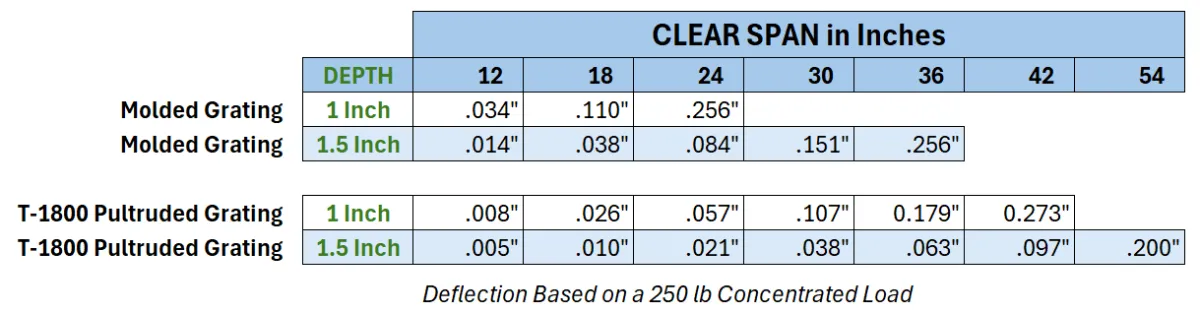
A key factor in selecting the right grating is knowing how much deflection you can expect and any given span.
Clear Span in the Load Capacity Chart below is the distance between the underlying structure that supports the grating.
For example; if your grating will be fastened to 2" wide supports spaced 24" on center, the clear span will be 22".
Deflection on the chart represents how far the grating will bend based on a 250 concentrated load. (Picture a 150 lb person standing on one foot in the middle of the span) A heavier person will have more deflection.
Select the complete load tables for each profile below which show the deflection for many more loads and spans.
Molded Grating Clips
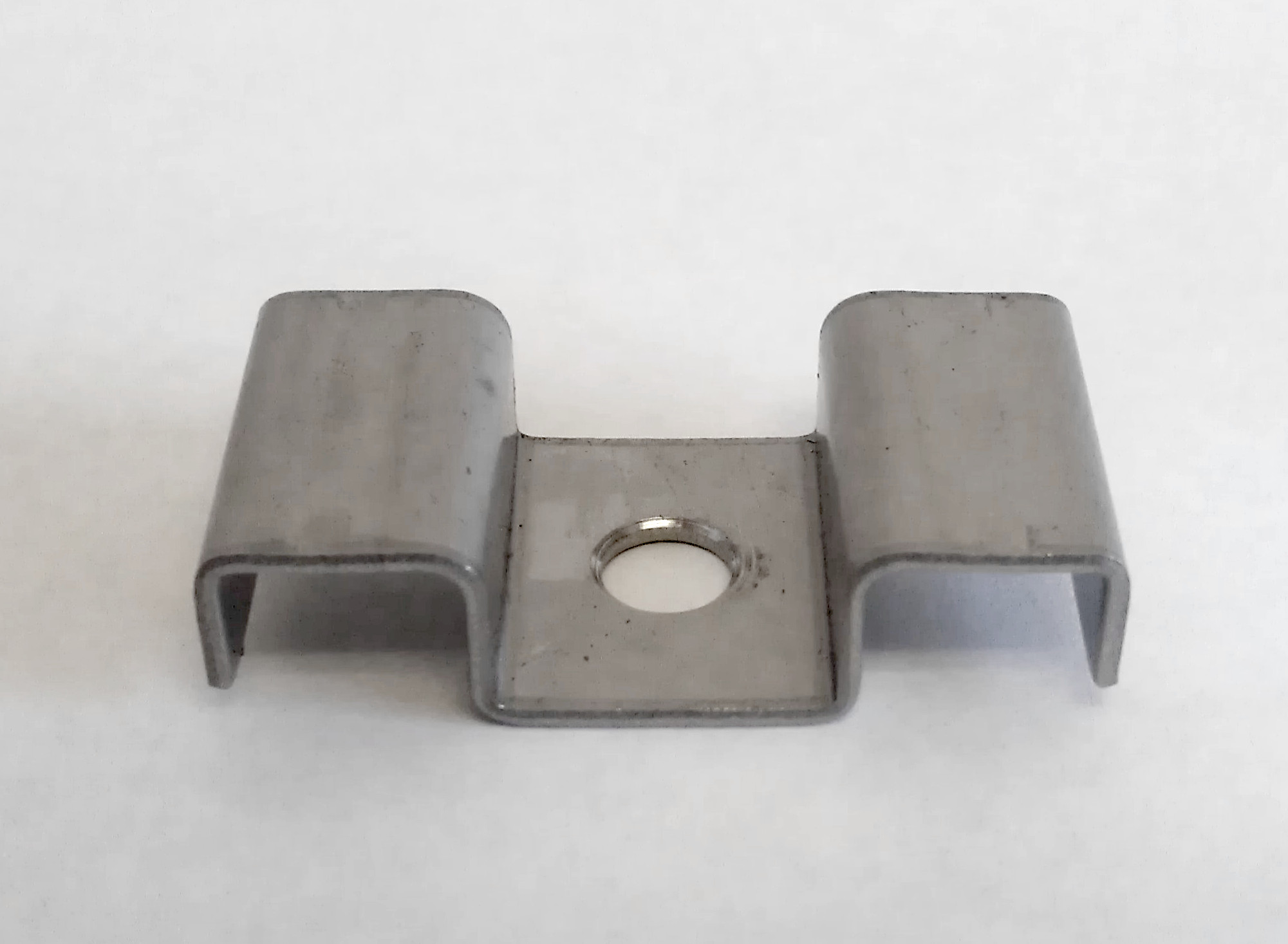
316 S.S. M-Clip
M-CLIP Grating Sizes
Mini-mesh 1" Deep
Mini-mesh 1.5" Deep
1.5" x 1.5"Square Mesh
2" x 2" Square Mesh
Pultruded Grating Clips
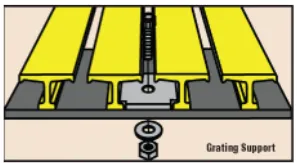
316 S.S. Insert Clip
Insert Clip CLIP Grating Sizes
T-1800 ( 1" & 1.5" )
I-4000 ( 1" & 1.5" )
I-6000 ( 1" & 1.5" )
T-5000 2" Deep
Fasteners are recommended every 3 feet. Closer together for intense marine conditions.
We can supply a standard bolt assembly for through bolting, however wood screws are best sourced locally.
Compare FRP Grating to Wood and Steel at Best Alternative to Wood Dock Decking for Marinas and Waterfront Docks

Fiberglass Grating for Marine Applications